Introduction
MatrixCatch is a tool
designed to search potential composite elements (CEs) in DNA sequences. MatrixCatch
uses a library of experimentally identified
CEs collected in TRANSCOMPEL® database as well as mononucleotide
position weight matrices (PWM) for single binding sites (BS) for
transcription factors (TF) collected in TRANSFAC®.
As an input MatrixCatch requires:
- DNA sequence(s) in FASTA, EMBL or plain sequence formats (see below);
- Type of multiple testing correction, maximum P-Value or target frequency of CEs;
As an output MatrixCatch gives a list of potential CEs, their positions, scores, p-values and respective links to the specific CEs in the database.
Advantages:
- Higher accuracy: MatrixCatch performs much better that CompelPatternSearch (Kel-Margoulis et al., 2002) and similar to the method specifically developed for recognition of NFATp/AP-1 (Kel et al., 1999).
- Wider scope: MatrixCatch is able to identify 265 types of CEs, what is similar to CompelPatternSearch and much more than just one NFATp/AP-1.
Brief description of the method
The idea behind MatrixCatch was
to complete the knowledge about variation of DNA sequences in composite
elements by taking into account sequence variation for
respective single binding sites. As a typical example, let us discuss
CE Sp1/E2F-1. It has been experimentally identified only in two genomic
locations (TRANSCOMPEL® numbers Ñ00132 and Ñ00226), providing two DNA
stretches for analysis. At the same time,
single binding sites for Sp1 and E2F-1 (independently from each other)
were detected experimentally in 108 and 39
locations respectively.
To take this advantage, we constructed an integral model for every CE, which consists of (Figure 1) :
- position weight matrix (PWM) for first binding
site, score and orientation;
- position weight matrix (PWM) for second binding
site, score and orientation;
- distance between both sites.
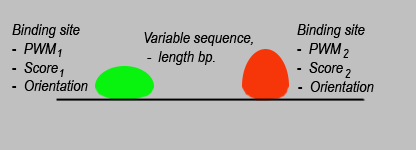
Figure 1. Model of composite element.
To find potential CE of the specific type (for example, Sp1/E2F-1 or NFAT/AP-1) MatrixCatch
will apply all existing models for this type of CE (respectively two
models for Sp1/E2F-1 and 15 for NFAT/AP-1). DNA sequence is reported as
potential CE if: both PWMs can recognize binding sites in correct
orientation with a scores higher than the respective scores defined in
the model, distance between these two sites lies within length
variation defined by the model.
To search for "non perfect" matches, user may
low the required PWM scores and increase length variation. In addition,
a composite score and P-Value parameters are provided. Composite score reflects
compensatory effect of cooperative binding, which allows one of the
binding sites to be weaker than defined in the model, provided that
another is stronger. P-Value shows statistical significance of the
results.
Input parameters
DNA sequence formats: plain, FASTA, EMBL.
Plain sequence format:
(All new lines, blanks and
characters other than A,T,G,C will be ignored, characters can be in
UPPER or lower case, lines can be of different length.)
TAGTGATCCgcgccacccggatcctttgcaATCTTCGCTTCAACACTTCAACAACCCCC
AACGTGGCTTACTTGTCAGTTTTACACCGTgtCG
ACGC
ATATCcaagatGTCATGCCGATTCGTGTAGAATATTGGTACCTCCCTAGACTA
gccagcaacccaacctagataccatgtcatgtagctccatccatatagtactccttagcataggagaaaagtcctgagcgatcacgaa
FASTA format:
>seq1
TAGTGATCCgcgccacccggatcctttgcaATCTTCGCTTCAACACTTCAACAACCCCC
AACGTGGCTTACTTGTCAGTTTTACACCGTgtCG
ACGC
ATATCcaagatGTCATGCCGATTCGTGTAGAATATTGGTACCTCCCTAGACTA
gccagcaacccaacctagataccatgtcatgtagctccatccatatagtactccttagcataggagaaaagtcctgagcgat
cacgaa
EMBL format:
(Only the essential fields to recognize an entry in EMBL format are shown. More fields may be included.)
ID Sequence 1, example
SQ
TAGTGATCCgcgccacccggatcctttgcaatCTTCGCTTCAACACTTCAACAACCCCCC
AACGtGGCTTACTTGTCAGTTTTACACCGTGTCGGTAGTATAGAAGGAGCCACAGGGGAC
ACGCATATCCAAGatgtcatgccgattcgtGTAGAATATTGGTACCTCCCTAGTTAGAGA
TAGGATTGCCACGCCACTAAAAgacgcccggTGACGGTTAGCATAATTATCCTGAAACTG
GTTCGATTGGCTGCTGCAGATCTAGACGCCACGCCAGCAACCCAACCTAGATACCATGTC
atgtagctccatccatatagtactccttagcataggagaaaagtcctgagcgatcacgaa
//
or
ID Sequence 1, example
SQ Sequence 360 BP; 63 A; 92 C; 97 G; 108 T; 0 other;
ctgcagcccc ggtttcgcaa agttaataat tttcagccgc gcacgtggtt ggccaaaccg 60
caccctcctt cccgtcgttt cccatctctt cctcctttag agctaccact atataaatca 120
gggctcattt tctcgctcct cacaggctca tctcgctttg gatcgattgg tttcgtaact 180
ggtgagggac tgagggtctc ggagtggatt gatttgggat tctgttcgaa gatttgcgga 240
ggggggcaat ggcgaccgcg gggaaggtga tcaagtgcaa aggtccgcct tgtttctcct 300
ctgtctcttg atctgactaa tcttggttta tgattcgttg agtaattttg gggaaagctt 360
//
P-Value multiple testing correction
P-value is calculated by the formula:
P-value = 1 - (1 - p*q)abs(L-Lm),
where p, q - frequencies of PWM hits with thresholds S1 and S2 respectively. S1,2 are the actual PWM scores and L is the actual distance between beginnings of BS. Frequency tables were generated in advance on 100 Mb random sequence with equal nucleotide distribution.
Four types of multiple testing
correction can be applied. List of CEs first ordered according to
P-value with smallest values on top. #CE - rank of CE in the
sorted list. After correction of P-Values, the list is again sorted.
- Bonferroni: new P-value = P-value * SequenceLength;
- Bonferroni step-down: new P-value = P-value * (SequenceLength - #CE);
- Benjamini and Hochberg: new P-value = P-value * (SequenceLength / #CE);
- No correction.
Relaxation values:
To
be able to search for "non-perfect" matches, some parameters of the
original CE model may be relaxed. This can be achieved by
decreasing PWM score (can be lowered down by maximum 0.25 (25%) of the original
score defined in a model) and increasing length variation (maximum is
5: if original distance were 10bp, than 10±50bp (i.e. from -40bp to
60bp) will be allowed. Please note, distance may have negative value,
which in such cases indicates that the second binding site is now
starts before the fist. Here we always regard "first" and "second" BS
according to the their order in the CE model.
Composite score (CS) reflects mutual effect of cooperative binding and defined by the formula:
CS=(Thr1-S1 )/Thr1 + (Thr2-S2 )/Thr2 + abs(L-Lm)/53.62,
where S1,2 are the actual PWM scores and L is the actual distance between beginnings of BS. Thr1,2 are PWM scores defined by the CE model.
The lower CS is the better is the overall similarity. Please note: negative values
of CS are relevant and indicate that the matched DNA sequence(s) has
higher PWM score(s), than it is required by the model. For practical
use, it can be suggested (if no other pre-knowledge exists)
to use the same value as for PWM scores, which will allow only one of
two BSs to be weaker. Length
variation can be set to 0.5
Recognition characteristics
To investigate a recognition characteristics of MatrixCatch we
tested it on the most investigated type of composite element NFAT/AP-1.
15 different examples of this CE are known. We also apply previously developed approaches
CompelPatternSearch (Kel-Margoulis et al., 2002)
and method specifically developed for recognition of NFATp/AP-1 (Kel et al.,
1999). Using "Jack Knife" method we sequentially removed CEs one by one
and tried to detect the whole set of CEs by relaxing search
parameters. False positive rate (over-prediction) was calculated using a
set of exon
sequences from human genome. Resulted values are shown on Figure 2 and
Table 1.
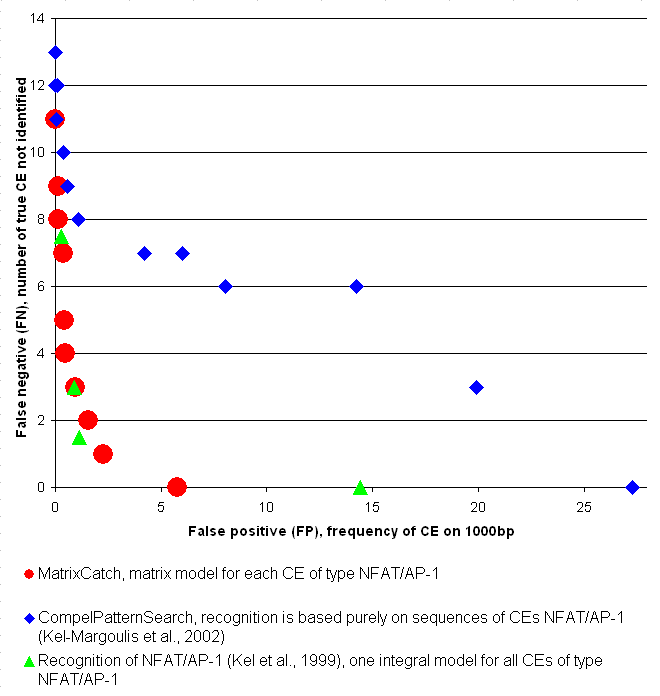 Figure 2. Recognition characteristics of three methods.
Table 1. Comparison of two methods - MatrixCatch and CompelPatternSearch.
Additional information about single binding sites significantly improves the quality of recognition.
| False
negative, FN (%) |
75% |
60% |
50% |
40% |
20% |
0% |
| MatrixCatch |
0,040883 |
0,302535 |
0,310711 |
0,787719 |
1,880621 |
11,5372 |
| CompelPatternSearch |
0,065735 |
0,32046 |
1,0682 |
8,036154 |
19,89318 |
27,31306 |
| fold
difference |
1,61 |
1,06 |
3,44 |
10,20 |
10,58 |
2,37 |
References
- Kel-Margoulis O.V., Kel A.E., Reuter I., Deineko IV, Wingender
E. TRANSCompel: a database on composite regulatory elements in eukaryotic
genes. Nucleic Acids Res. 2002, 30, 332-334.
- Kel A, Kel-Margoulis O, Babenko V, Wingender E. Recognition
of NFATp/AP-1 composite elements within genes induced upon the activation of
immune cells. J Mol Biol. 1999, 288, 353-376.
|